Updated May 11, 2020. The number of COVID-19 cases linked to slaughterhouses is now over 10,000, and at least 45 workers are known to have died, according to a USA Today report. So far around 40 meatpacking plants have shut down, despite President Trump’s executive order that they remain open. The closures prompted US Secretary of Agriculture Sonny Perdue to release a statement warning “further action” against plants that don’t reopen. In Arizona, the JBS slaughterhouse in Tolleson has remained open, despite reports of workers contracting COVID-19. Plant employees recently told ABC15 they “fear catching coronavirus and want the company to shut down the facility for up to two weeks to ensure it is properly cleaned.” However, the plant continues 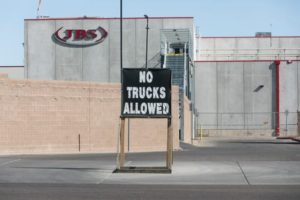 to operate. This is the same facility that recalled over 6.5 million pounds of beef in 2018. The slaughterhouse also has a history of cruel treatment of animals. In July of 2017, the USDA’s Food Safety and Inspection Service issued a notice accusing the facility’s president of enabling “egregious” and “inhumane” practices with livestock. The USDA inspector noted two downed cows suffering in holding pens. The report described a cow “lying on her side and unable to rise, mentally incoherent, having difficulty breathing, and repetitively making a kicking motion with its legs while moaning as if in pain.” Suffering animals are not unique to the Tolleson slaughterhouse, but are a component of the abuse of America’s large-scale industrial agriculture. COVID-19 has made it strikingly clear that this country’s dependence on factory farming and mass slaughter for cheap meat has deadly consequences.
Matthew Scully’s latest piece,
The Human Cost of ‘Culling’ Livestock and ‘Depopulating’ Farms delves into the killing of millions of confined farm animals in the midst of the COVID-19 pandemic. Factory farmers use euphemisms like ‘depopulation’ and ‘culling’ to mask their brutal, painful methods of killing pigs, cows, chickens, and other animals confined in large industrial agriculture operations across the US. He discusses that during a global pandemic, the Trump administration ordered slaughterhouses to remain open and deemed them “essential”. The administration and USDA are also fast-tracking a rule to loosen regulations and speed up pig slaughter operations. According to the Animal Legal Defense Fund, the euphemistically-titled Modernization of Pork Slaughter allows slaughterhouses to kill pigs at extremely high line speeds, which was previously limited to killing 1,106 pigs per hour. The rule also cuts the training and numbers of inspectors overseeing slaughter operations, jeopardizing consumer and worker safety. ALDF and other organizations filed a
lawsuit to block the rule. In support of the lawsuit, USDA inspector Jill Mauer’s
statement was filed in federal court on April 10th. She confirmed that under the deregulated system, pigs are often still breathing when dropped into scalding tanks as evidenced by tank water found in their lungs.
According to Scully, while inhumanely killing millions of animals and deregulating slaughterhouses, the pork industry is asking for public sympathy and funding, referring to mass killings as “tragic choices,” “gut-wrenching decisions,” and “devastating last resorts.” He states, “Sometimes the failures in a system reveal the essence of the whole. Abnormal circumstances can clarify problems that pass for normal. Doubtless, in their “depopulation” measures, the livestock farmers themselves feel they have “nowhere to go,” forced by their own manias of consolidation and hyper-efficiency to make one harsh choice after another, all the conscientious alternatives long ago ruled out. Yet if somehow it troubles them, in their culling labors, to treat millions of living creatures as nothing — bulldozed away, like so much piled-up trash — then now’s a good moment, for all of us, to notice that the system is just as merciless when it is working to perfection.”
April 12, 2020. Thanks to the National Review for publishing
China’s Wet Markets, America’s Factory Farming by Matthew Scully – a powerful, thought-provoking piece on the consumption of animals as a
source of COVID-19 and other pandemics. We will always be grateful to Scully for his help in passing Arizona
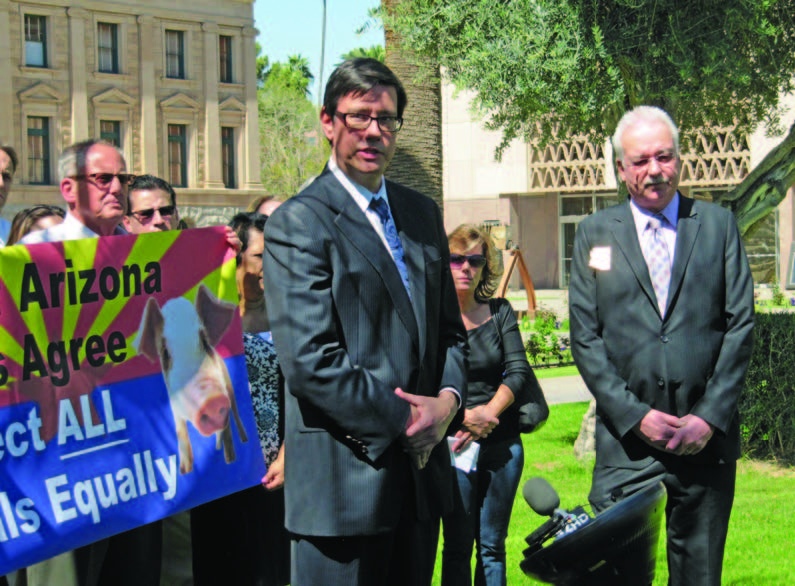
Prop 204. In 2006, ADLA, HSUS, AZ Humane Society, and Farm Sanctuary led a grassroots citizen initiative campaign to ban the inhumane confinement of pregnant pigs and calves raised for veal in industrial agriculture operations. That February, the Arizona Republic published Scully’s passionate piece “
A Sunless Hell” – a graphic depiction of animal suffering in factory farms and powerful plea to end cruel confinement practices. That November, Arizona voters passed the Humane Farm Animal Act by a landslide margin of 62% to 38%, despite initiative opponents outspending our coalition by almost two to one.
As Scully suggests, the cruelty humans inflict on animals extends beyond live-animal markets in China to America’s own factory farms where extreme confinement has led to massive antibiotic use and subsequent resistance – an “infectious time bomb.” To prove his point, on April 10th it was
reported that workers in a South Carolina commercial meat plant killed over 32,000 turkeys due to an outbreak of highly pathogenic avian influenza H7N3. So far humans have not been widely affected but some health experts
expressed concern that this type of virus has the potential to cause a pandemic if it changes and becomes transmissible to humans.
Scully points out following worldwide public outrage over live-animal markets, its managers’ response was to stop people from exposing them. He states, “When the Daily Mail describes how
Chinese guards at the live-animal market now “try to stop anyone from taking pictures,” who does that remind us of? How about our own livestock companies, whose entire mode of operation these days is systematic concealment by efforts to criminalize the taking of pictures in or around their factory farms and slaughterhouses?”
This has certainly been the case in Arizona, where the Legislature has attempted to pass
numerous bills to silence citizens at the behest of the livestock industry. Animal Defense League of Arizona and other animal protection groups have fought since 2004 against “ag-gag” bills and other legislation to criminalize those who document inhumane treatment of farm animals. Fortunately all of the
ag-gag bills were defeated, but agriculture lobbyists continue to find creative ways of silencing concerned citizens.
“How many diseases, cullings, burial pits, and bans on photographing these places even at their wretched best will we need before realizing that the entire system is profoundly in error, at times even wicked, and that nothing good can ever come of it?” Scully asks.
His article is difficult to read but ends on an optimistic note: “Plagues, as we’re all discovering, have a way of prompting us to take stock of our lives and to remember what really matters. If, while we’re at, we begin to feel in this time of confinement and fear a little more regard for the lives of animals, a little more compassion, that would be at least one good sign for a post-pandemic world.”